
Case study · Fintech & POS · Clover
Clover Payroll
Making a third-party payroll system feel native to Clover, and finding the gaps that would have broken it.
Clover, a Fiserv company: point-of-sale hardware and business management software for small and mid-sized businesses. Clover generated $3.3B in revenue in 2025 inside Fiserv, a Fortune 500 fintech with $19.8B in revenue.
My role
Sole product designer from kickoff through the end of the engagement.
Team
Product Owner and Lead Engineer, in a small, fast-moving agile environment.
Scope
Functional and content requirements, information architecture, user flows, UI design.
Outcome
The partnership was severed before launch. The employee experience framework outlived it.
2024 · Fintech & POS · SMB · B2B · B2B2C · SaaS · Zero to 1 · Sole product designer
Overview
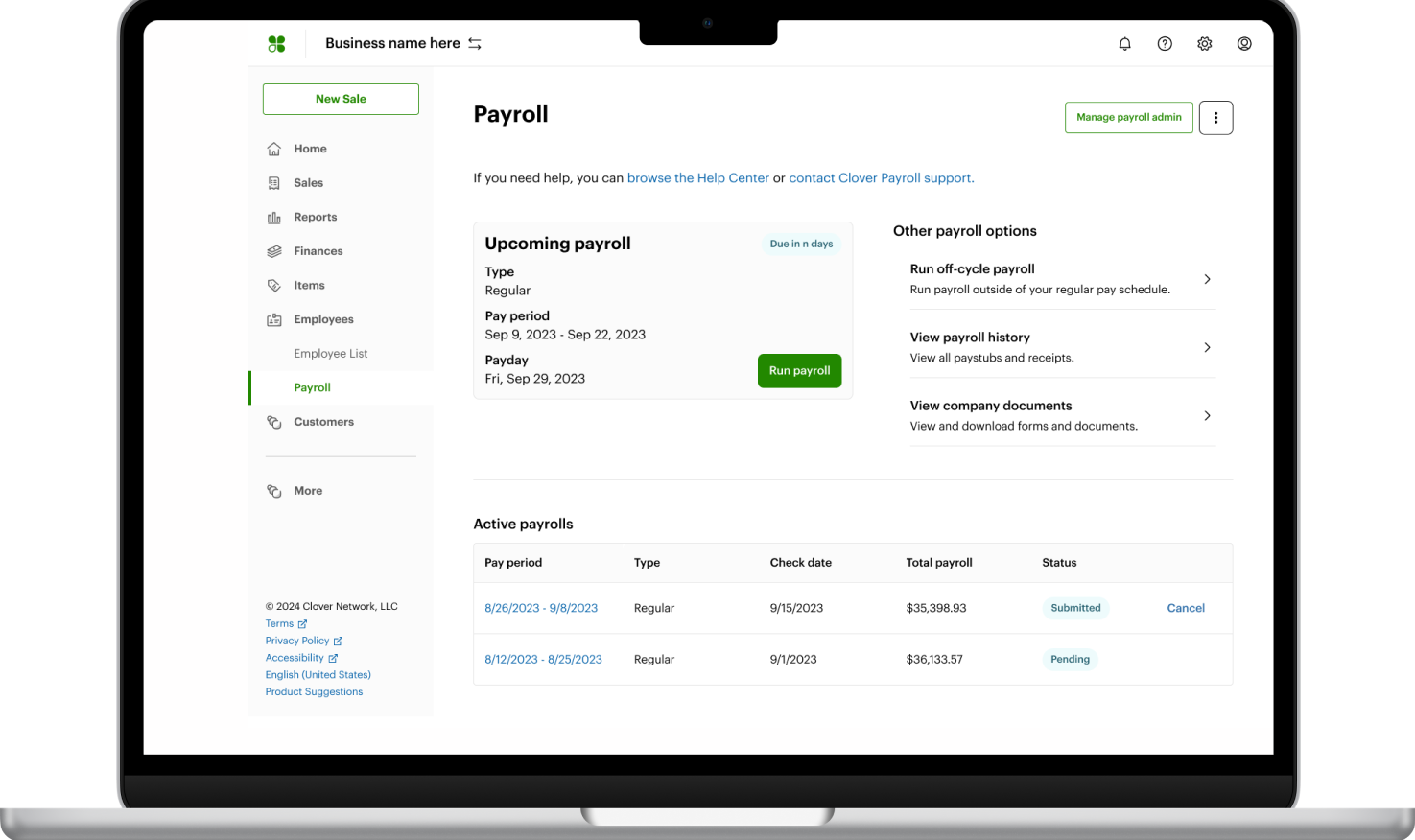
Clover wanted to add payroll functionality to its employee management system, and fast. The business had already selected a third-party payroll provider. My job was to integrate it into Clover’s existing framework in a way that felt native, not bolted on.
What looked like a straightforward integration turned into something more significant. Mid-project, I identified foundational gaps in Clover’s employee management system that would have broken the payroll experience entirely. That discovery reshaped the scope and ultimately produced something more durable than the original ask.
Challenges
The integration challenge
The core design problem was making an iframed third-party system feel like a seamless part of Clover’s product. That meant more than visual consistency. It meant designing flows that moved users across the boundary between systems without exposing the seam, and making sure the handoffs between Clover-owned and third-party-owned surfaces felt intentional rather than accidental.
The timeline was tight and the flow was evolving constantly. Product, Design, and Engineering were modifying requirements and use cases almost daily as new edge cases surfaced during build. Staying aligned while keeping the design coherent required tight communication and a willingness to make decisions quickly and document them clearly.
Designing the seam
The business chose an iframe-style integration for speed of delivery, which left us with minimal control over the vendor’s pages. So the design work moved to everything around them.
Own every page we could. We built as much of the flow in Clover as possible and served vendor pages only where we had no choice. Running all of payroll on the vendor’s pages would have been faster, but it wouldn’t have carried Clover’s quality or the trust merchants place in it.
Keep the frame on pages we couldn’t control. A Clover header stayed on every vendor page, so users never felt they had left our system.
Give up navigation mid-workflow. On vendor pages we removed site navigation, trading flexibility for focus, so users couldn’t wander off partway through payroll setup or lose track of where they were.
The discovered problem
Midway through the project I identified that Clover’s employee management system lacked features the payroll integration depended on: specifically, the ability for all employees (not just managers) to log in to the business management system, and a place to store employee documents.
These weren’t edge cases. They were blockers. Without them, the payroll flow couldn’t function for the people it was designed to serve.
Rather than flag the gaps and wait, I worked with the product team to define and design the missing employee management features in parallel with the integration work. This turned a potential project risk into an expansion of scope that was already aligned with where Clover was heading as a platform.

The full user flow, color-coded by who owns each surface. Clover owned everything it could; the partner’s pages appeared only where they had to.
What we built
The final design covered a fully integrated payroll experience for both managers and employees, with flows that handled setup, initiation, and ongoing management across both Clover-owned and third-party surfaces.
The employee-facing experience was net-new for the platform. It established a design foundation that gave Clover the ability to support employee access across other products going forward, not just payroll.
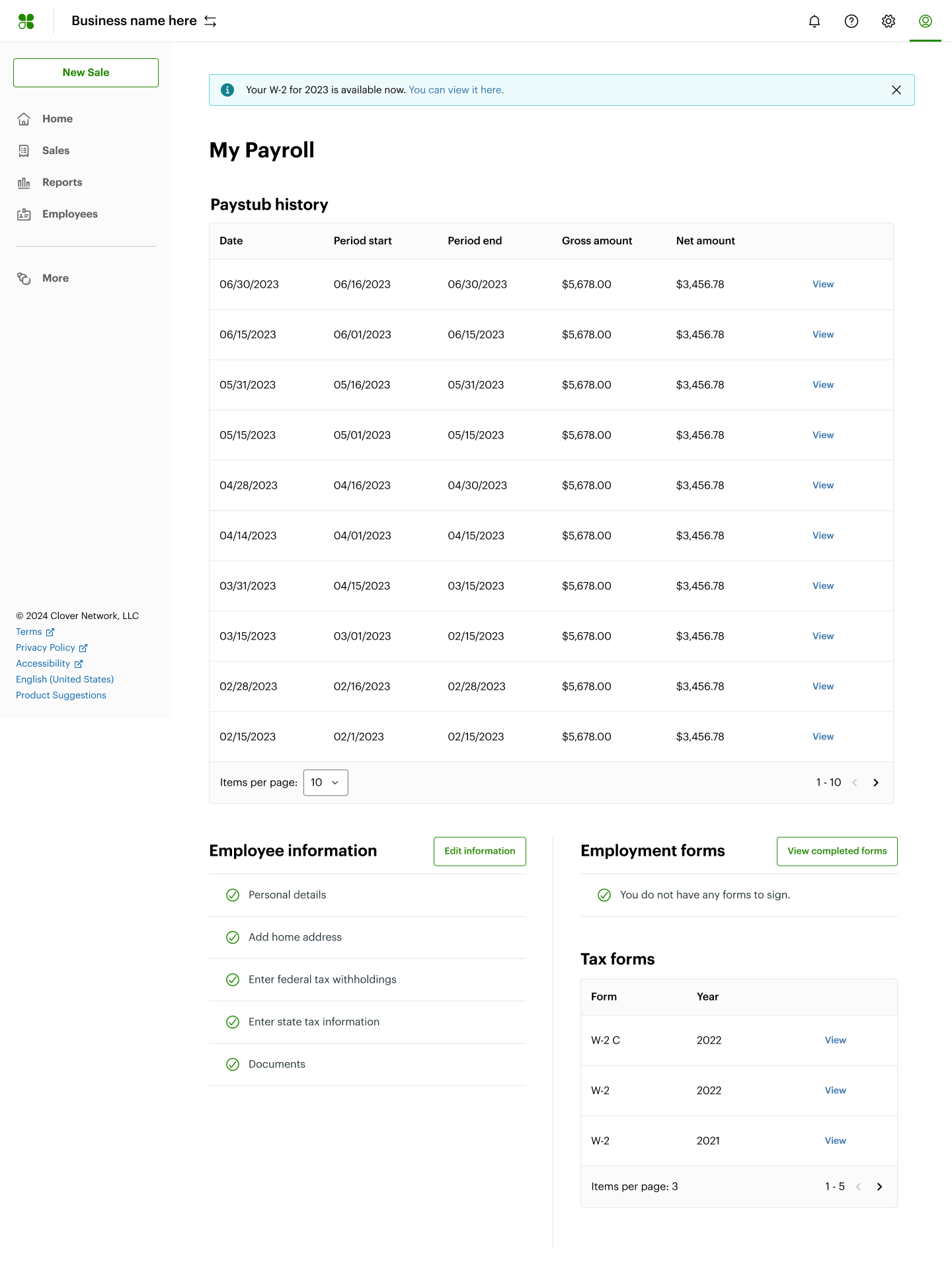
The new Employee paystubs and documents area
Outcome
The payroll partnership was severed before launch, and this version did not ship.
The groundwork did. Clover has since launched embedded payroll with a new partner, including employee self-service access to pay stubs and tax forms: the all-employee access and document foundation this project first defined.
Some of the most durable design work doesn’t ship in the form you designed it.
My role on this project
Working directly with the Product Owner and Lead Engineer in a small, fast-moving team meant there was no room for ambiguity in design decisions. I had to make calls quickly, communicate rationale clearly, and keep the work moving even when requirements were shifting underneath it.
Sole product designerFunctional & content reqsInformation architectureUser flowsUI design